

Goal setting is everywhere in our world. We set goals for our careers, our health, and our lives in general. It seems modern society is always encouraging us to think about the next milestone. However, what we don't think about enough is the science and strategy of how to accomplish your goals. That's what this guide is here to do.
I. What is Goal Setting?
Most goal setting exercises start with an overpaid consultant standing by a whiteboard and asking something like, "What does success look like to you? In very specific terms, what do you want to achieve?"
If we are serious about achieving our goals, however, we should start with a much different question. Rather than considering what kind of success we want, we should ask, "What kind of pain do I want?"
The real challenge is not determining if you want the result, but if you are willing to accept the sacrifices required to achieve your goal. Do you want the lifestyle that comes with your quest? Do you want the boring and ugly process that comes before the exciting and glamorous outcome?
Goal setting is not only about choosing the rewards you want to enjoy, but also the costs you are willing to pay.
Rudders and oars

Imagine a small row boat. Your goals are like the rudder on the boat. They set the direction and determine where you go. However, there is another part of the boat that is even more important than the rudder: The oars. If the rudder is your goal, then the oars are your process for achieving it. While the rudder determines your direction, it is the oars that determine your progress.
- If you're a coach, your goal is to win a championship. Your system is what your team does at practice each day.
- If you're a writer, your goal is to write a book. Your system is the writing schedule that you follow each week.
- If you're a runner, your goal is to run a marathon. Your system is your training schedule for the month.
- If you're an entrepreneur, your goal is to build a million dollar business. Your system is your sales and marketing process.
Goals determine your direction. Systems determine your progress. You'll never get anywhere just by holding the rudder. You have to row.
II. How to Set Goals You'll Actually Follow
1. Ruthlessly eliminate your goals

Psychologists have a concept they refer to as "goal competition." Goal competition says that one of the greatest barriers to achieving your goals is the other goals you have. In other words, your goals are competing with one another for your time and attention.
One of the fastest ways to make progress on your goals is to simply press pause on less important things and focus on one goal at a time. What often looks like a problem of goal setting is actually a problem of goal selection. What we really need is not bigger goals, but better focus.
Our goals are similar to a rose bush. They need to be consistently pruned and trimmed down. If we can muster the courage to prune away a few of our goals, then we create the space we need for the remaining goals to fully blossom.
2. Stack your goals
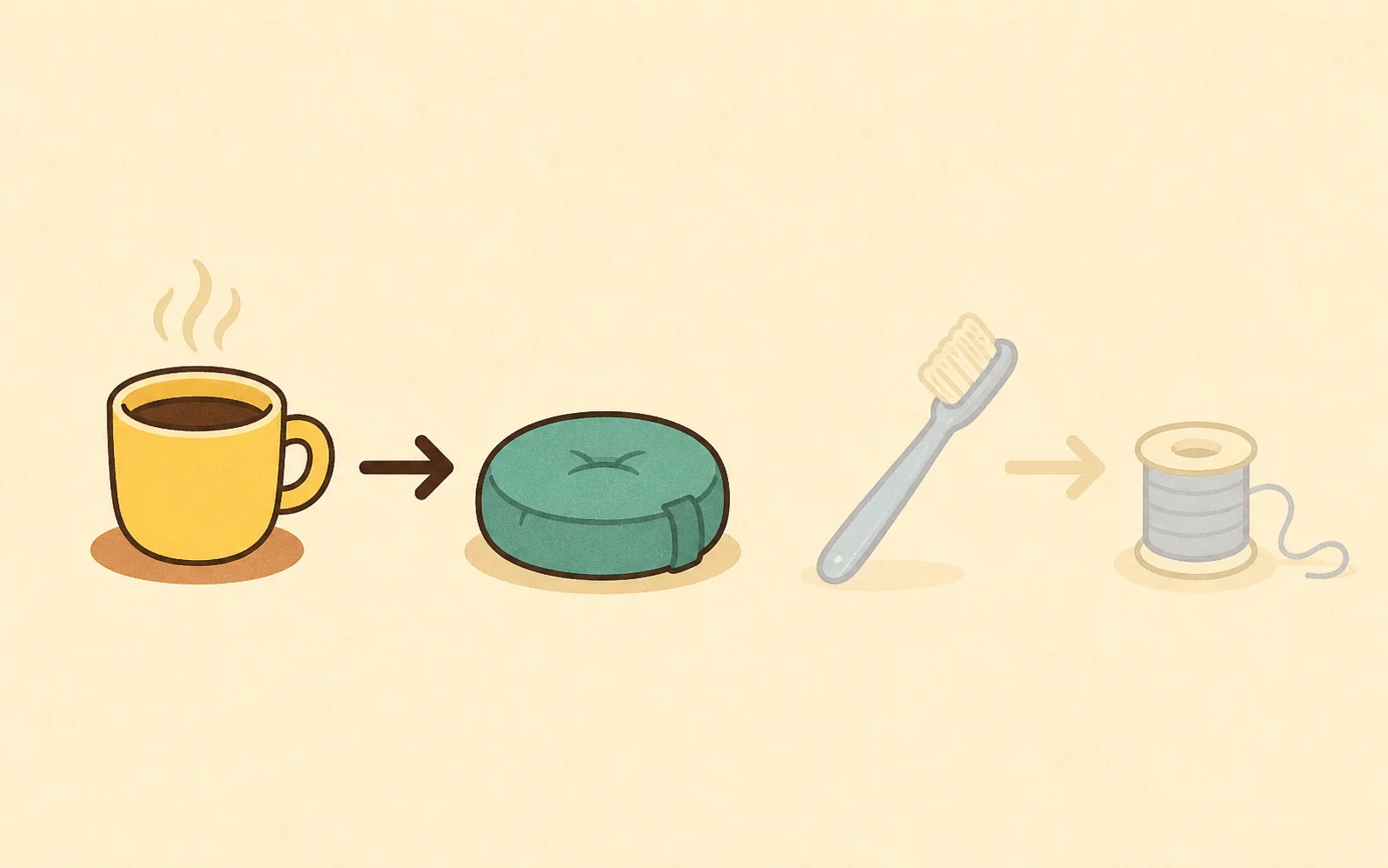
Research has shown that you are 2x to 3x more likely to stick to your goals if you make a specific plan for when, where, and how you will perform the behavior. Psychologists call these specific plans "implementation intentions" because they state when, where, and how you intend to implement a particular behavior.
One of my favorite ways to utilize this finding is with a strategy I call habit stacking. To use habit stacking, just fill out this sentence:
After/Before [CURRENT HABIT], I will [NEW HABIT].
- Meditation: After I brew my morning coffee, I will meditate for one minute.
- Pushups: Before I take my morning shower, I will do 10 pushups.
- Flossing: After I set my toothbrush down, I will floss my teeth.
- Gratitude: Before I eat dinner, I will say one thing I am grateful for that day.
3. Set an upper bound
Whenever we set goals, we almost always focus on the lower bound. That is, we think about the minimum threshold we want to hit. But what would it look like if we added an upper bound to our goals and behaviors?
- "I want to lose at least 5 pounds this month, but not more than 10."
- "I want to make at least 10 sales calls today, but not more than 20."
- "I want to write at least 500 words today, but not more than 1,500."
There is a magical zone of long-term growth. You want to push hard enough to make progress, but not so much that it is unsustainable.
III. How to Achieve Your Goals Consistently
Effective goal setting requires consideration of the system that surrounds you. Too often, we set the right goals inside the wrong system. If you're fighting your system each day to make progress, then it's going to be really hard to make consistent progress.
How to align your environment with your goals
Although most of us have the freedom to make a wide range of choices at any given moment, we often make decisions based on the environment we find ourselves in.
- If you sleep with your phone next to your bed, then checking social media and email as soon as you wake up is likely to be the default decision.
- If you walk into your living room and your couches and chairs all face the television, then watching television is likely to be the default decision.
- If you keep alcohol in your kitchen, then drinking consistently is more likely to be the default decision.
Of course, defaults can be positive as well.
- If you keep a dumbbell next to your desk at work, then pumping out some quick curls is more likely to be the default decision.
- If you keep a water bottle with you throughout the day, then drinking water rather than soda is more likely to be the default decision.
- If you place floss in a visible location, then flossing is more likely to be the default decision.
Strategies for designing better defaults:
- Simplicity. When in doubt, eliminate options.
- Visual Cues. Use methods like the Paper Clip Method or the Seinfeld Strategy.
- Opt-Out vs. Opt-In. Schedule future sessions while you are feeling motivated today.
How to measure your goals
Another key to making long-term progress on your goals is measurement. The human mind loves to receive feedback. One of the most motivating things we can experience is evidence of our progress. This is why measurement is so critical for effective goal setting.
The things we measure are the things we improve. It is only through numbers and clear tracking that we have any idea if we are getting better or worse.