Stop Task Paralysis: Why 'Reverse Prompting' Cures Goal Overwhelm for ADHD Minds
It’s 10:30 AM on a Saturday. You promised yourself you would spend the weekend working on your passion project—writing your newsletter, cleaning the garage, or finally learning to code.
Instead, you’ve been sitting on the edge of the couch for 45 minutes, scrolling your phone, completely paralyzed.
You want to do the work. The desire is real. But your brain feels like an engine spinning in neutral, wheels screaming without gaining an inch of traction. In psychology and ADHD coaching, this state is known as Task Paralysis (or the "Wall of Awful").
Most productivity advice tells you to "just break it down into smaller steps" or "time-block your calendar." But for a neurodivergent or burnt-out brain, the act of planning itself triggers the paralysis.
Here is why traditional goal planning fails—and how Reverse Prompting (Goal-Seek Prompting) functions as a cognitive prosthetic to unstick your brain.
The Neurobiology of Why Planning Hurts
To understand why traditional planning backfires, you have to look at the prefrontal cortex—the part of the brain responsible for executive functioning:
[Raw Intention] ──▶ [Working Memory Overload] ──▶ [Prefrontal Exhaustion] ──▶ [Task Paralysis]
   "Clean house"       "Where are the bags?           "This is too much."        *Stares at phone*
                       What about the garage?
                       Do I need labels?"
When you tell someone with executive dysfunction to "Plan your month," their brain tries to compute hundreds of variables simultaneously:
- Time Blindness: "How long will this take? 20 minutes? 4 hours? I have no idea."
- Prioritization Gridlock: "Is step 3 more important than step 1? If I do step 2 first, will I ruin step 4?"
- Perfectionist Shame: "If I can't do this the right way, doing it poorly will just prove I'm lazy."
The brain perceives this mountain of ambiguous decisions as a threat, releases cortisol, and shuts down motivation. You freeze.
Why Reverse Prompting Bypasses the Mental Block
When using AI, most people attempt Generative Prompting: they try to write a 300-word prompt detailing every constraint. This requires the exact same executive function energy they are already lacking!
Reverse Prompting flips the cognitive burden entirely:
| Action | Generative Prompting | Reverse Prompting (Goal-Seek) |
|---|---|---|
| User's Starting Input | Write a complex 5-paragraph brief | Type one raw sentence ("I need to declutter my desk") |
| Cognitive Requirement | Synthesis, structuring, foresight | Recognition and simple factual recall |
| Brain Mode | Active creation under anxiety | Responsive dialogue with an external guide |
| Friction Level | Extreme | Nearly zero |
In neuroscience, recognition requires vastly less cognitive bandwidth than recall and synthesis.
When an AI asks you:
"Do you have a trash bag and 10 minutes right now, yes or no?"
Your brain doesn't have to construct a universe. It just has to say: "Yes."
The AI acts as an external prefrontal cortex, absorbing the structural chaos so you can focus solely on small physical actions.
The "Anti-Paralysis" Reverse Prompt
The next time you find yourself frozen and unable to start a task, copy this prompt into ChatGPT, Claude, or Gemini:
You are a warm, low-pressure executive function assistant.
I am experiencing task paralysis right now. I want to do something, but my brain is overwhelmed and I cannot figure out how to start.

My goal/task is simply this: [Insert raw task, e.g., "Sort through 3 weeks of unopened mail"]

Do NOT give me a long list. Do NOT give me a 10-step guide.

Instead, ask me exactly 2 very simple questions to help me identify the absolute smallest, zero-friction first physical action I can take in under 3 minutes.
An Actual Real-Life Run:
You: "I have to write a performance review for my job, and I've been dreading it for 4 days."
AI:
1. Can you open a blank document right now and title it 'Draft Review', without writing a single sentence of content yet?
2. Who is one person you collaborated with recently whose name you can write at the top of the page?
Notice what happened: the AI didn't ask you to evaluate your accomplishments. It asked you to create a file and write one name. The threshold of resistance dropped below the trigger point of paralysis.
The Container Solution: Goal Cans vs. Rigid Timelines
Once the AI helps you break down your paralyzing task into micro-steps, where do you put them?
If you paste them into a calendar with fixed times (e.g., 2:00 PM – 2:30 PM), you are setting yourself up for failure. When an ADHD brain misses a time block by 10 minutes, the schedule shatters, and task paralysis rushes back.
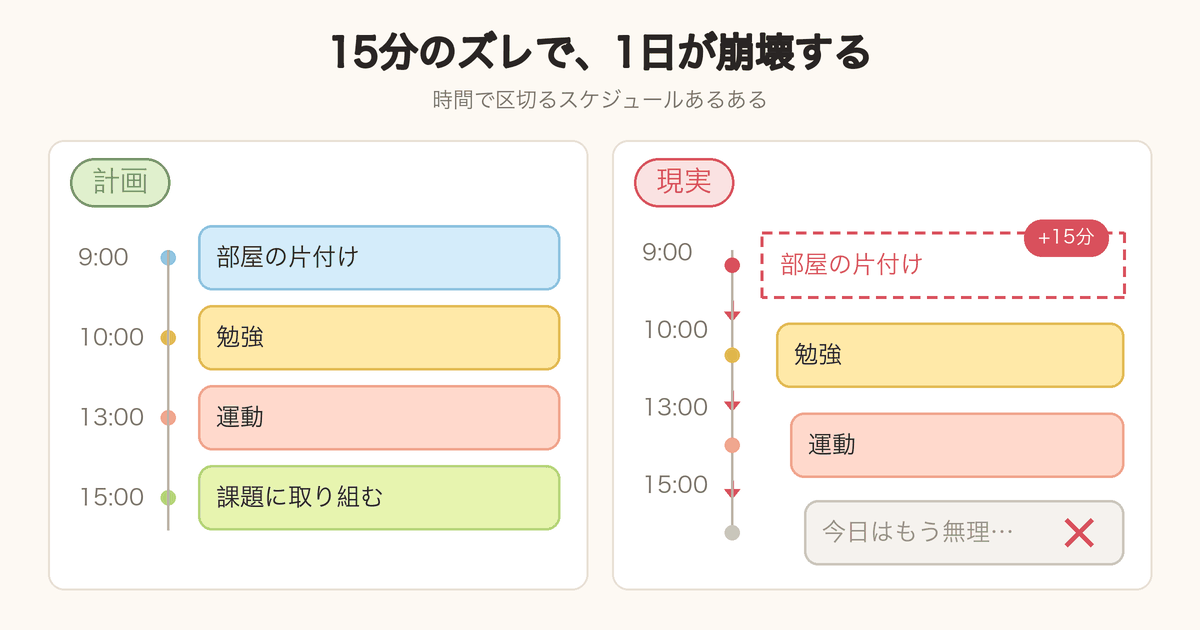 Rigid time-blocking punishes human unpredictability. Flexible containers protect your momentum.
This is why CanGoal replaces chronological timelines with Goal Cans:
- A Can is a Safe Container: You dump your micro-tasks into a Can (e.g., "Performance Review"). There are no ticking clocks or flashing red overdue alarms.
- Micro-Dopamine Hits: Checking off one tiny 2-minute step immediately triggers a cheerful celebration from your CanFriend companion, releasing the dopamine that neurodivergent brains naturally crave.
- Guilt-Free Pauses: Need to step away for three hours? When you come back, your Can is sitting right where you left it—intact, patient, and ready whenever you are.
Your 3-Minute Reset for Right Now
If you are reading this while feeling stuck on something you should be doing:
- Stop beating yourself up. Paralysis is neurobiology, not a character flaw.
- Open your AI app and paste the Anti-Paralysis prompt above.
- Take the single 2-minute action it suggests.
- Put the remaining steps into a CanGoal can, close your laptop for five minutes, and celebrate the fact that you broke the freeze.